ESG Data Isn’t Reporting Anymore. It’s Investment Intelligence.
Discover how transforming ESG data into structured investment intelligence can enhance decision-making and drive long-term value in asset management.
How private credit managers calculate financed emissions when borrowers won't reply: find the operating entity, estimate by loan type, score every figure.
Climate reporting assumes you can ask the company. In private credit, you often can't. You lent to a holding company, not the business that burns the fuel. You have no board seat, and the deal team owns the relationship. Here is how to produce a financed emissions figure you can defend anyway.
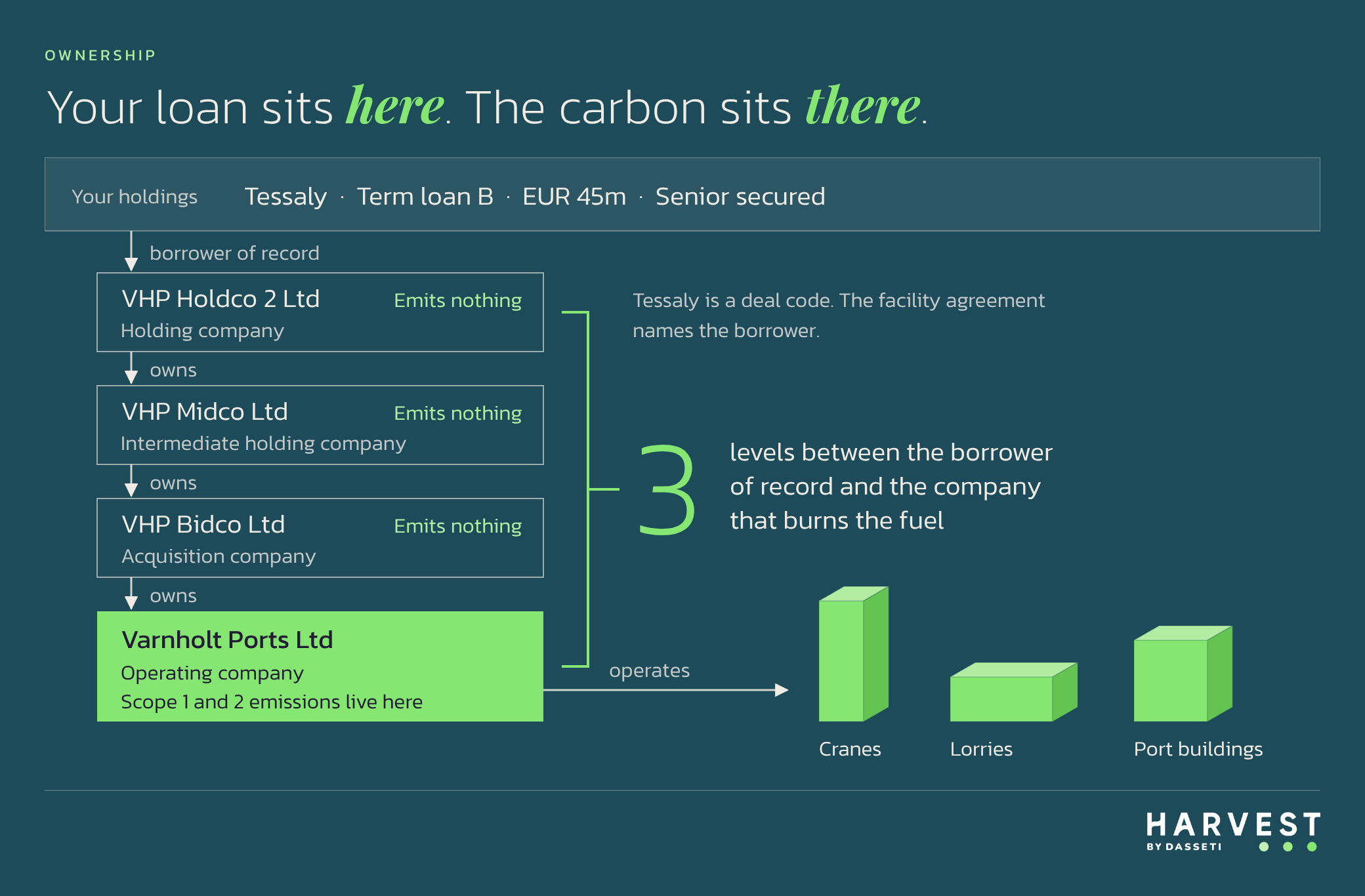
Here is one position from a private credit fund. Its names are invented, like every company and figure in this article's examples, but the structure is an ordinary one.
Try to find the carbon. There isn't any. Tessaly is the deal team's code name for the loan. The borrower behind it is VHP Holdco 2 Ltd, a holding company, and a holding company doesn't burn diesel, run cranes or send lorries through a port gate at four in the morning. The company that does is Varnholt Ports Ltd, three levels further down, and nothing in the code or the borrower's name points to it.
That gap is where private credit footprints go wrong. The attribution formula is simple: your outstanding loan, divided by the borrower's equity plus debt, multiplied by the borrower's emissions. The hard part hides inside that last phrase. You can't count a borrower's emissions until you know who the borrower really is.

Private credit lends to structures. Holding companies, special purpose vehicles, trusts and finance subsidiaries borrow on behalf of operations they don't run. A hotel group borrows through a holding company while the boilers sit in its hotels. A rolling-stock lessor borrows, but the trains carry the emissions. In each case the emitter is real. It just isn't the borrower.
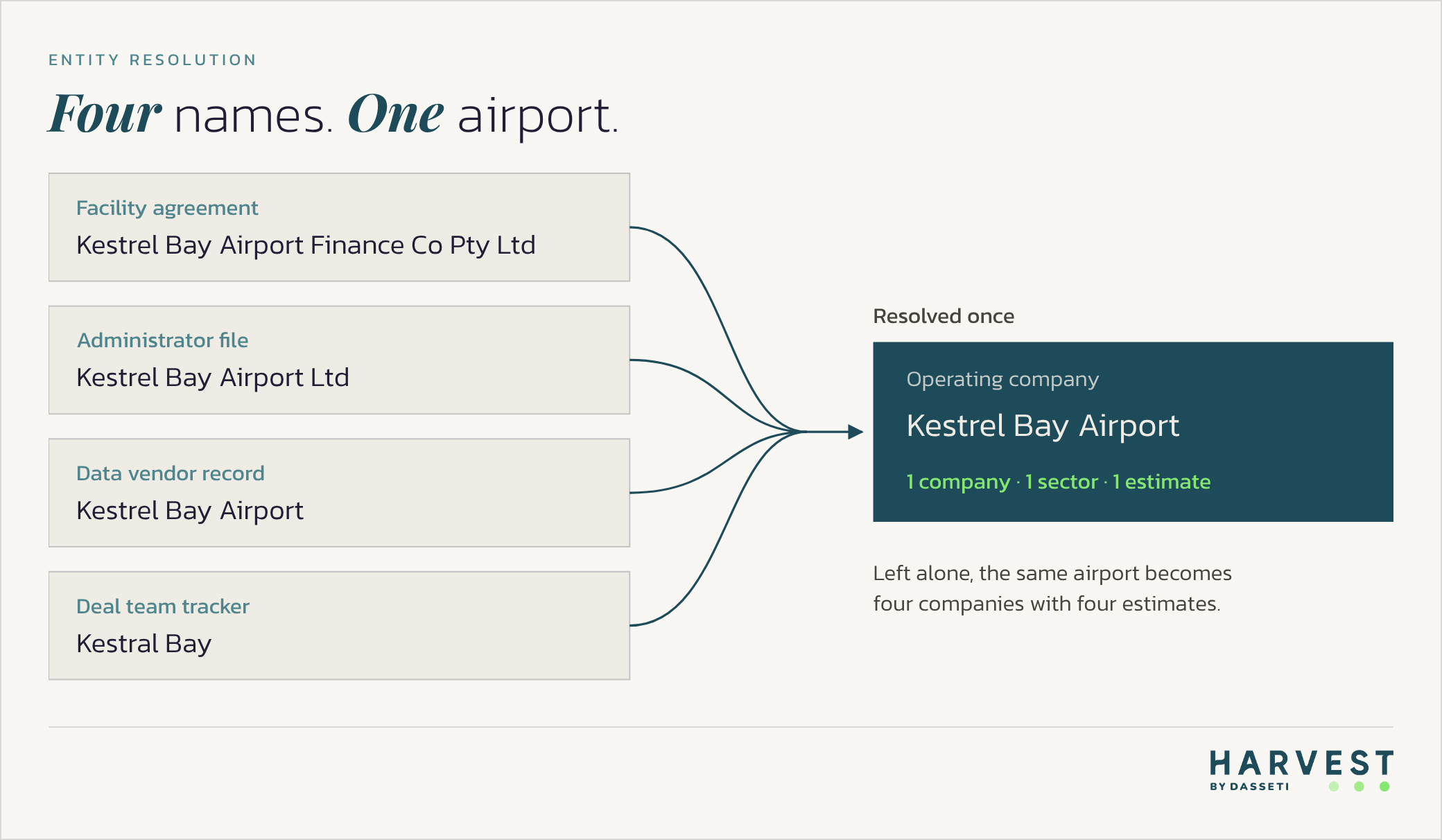
Nothing in the name says so. The deal team chose "Tessaly" and a lawyer chose "VHP Holdco 2 Ltd", and neither had an emissions database in mind. Because the structure has layers, every document names the layer it deals with: the facility agreement the finance company, the administrator's file the issuer, the vendor's record the group, and the deal team's tracker whatever they call it in conversation. So Kestrel Bay Airport arrives as four names, one of them a misspelling, and across two facilities in three funds it can appear six times.
The fix comes before any calculation. Positions stay where they are, one line per facility, per fund. Emissions are recorded once, against the operating company. A mapping joins the two, built by tracing each borrower to the company that runs the assets and kept from year to year, so the tracing is never done twice. Call that company the emitter nobody named: the entity that carries the carbon but never appears in your holdings. An estimate can only be as right as the entity it points at.

Here is the odd thing. A wrong name doesn't just blur the number. For the borrowers that matter most, the heavy emitters, it shrinks it.
Few private companies report their emissions, so lenders estimate them from revenue and a sector emission factor. The sector comes from whichever entity you recorded. Record a steelworks' holding company and the estimate uses a financial-services factor, which is low. Record the steelworks itself and it uses a heavy-industry factor, which is not. Same loan, same revenue, a fraction of the carbon. The lender to a steelworks ends up reporting as if it had lent to an office with a filing cabinet.
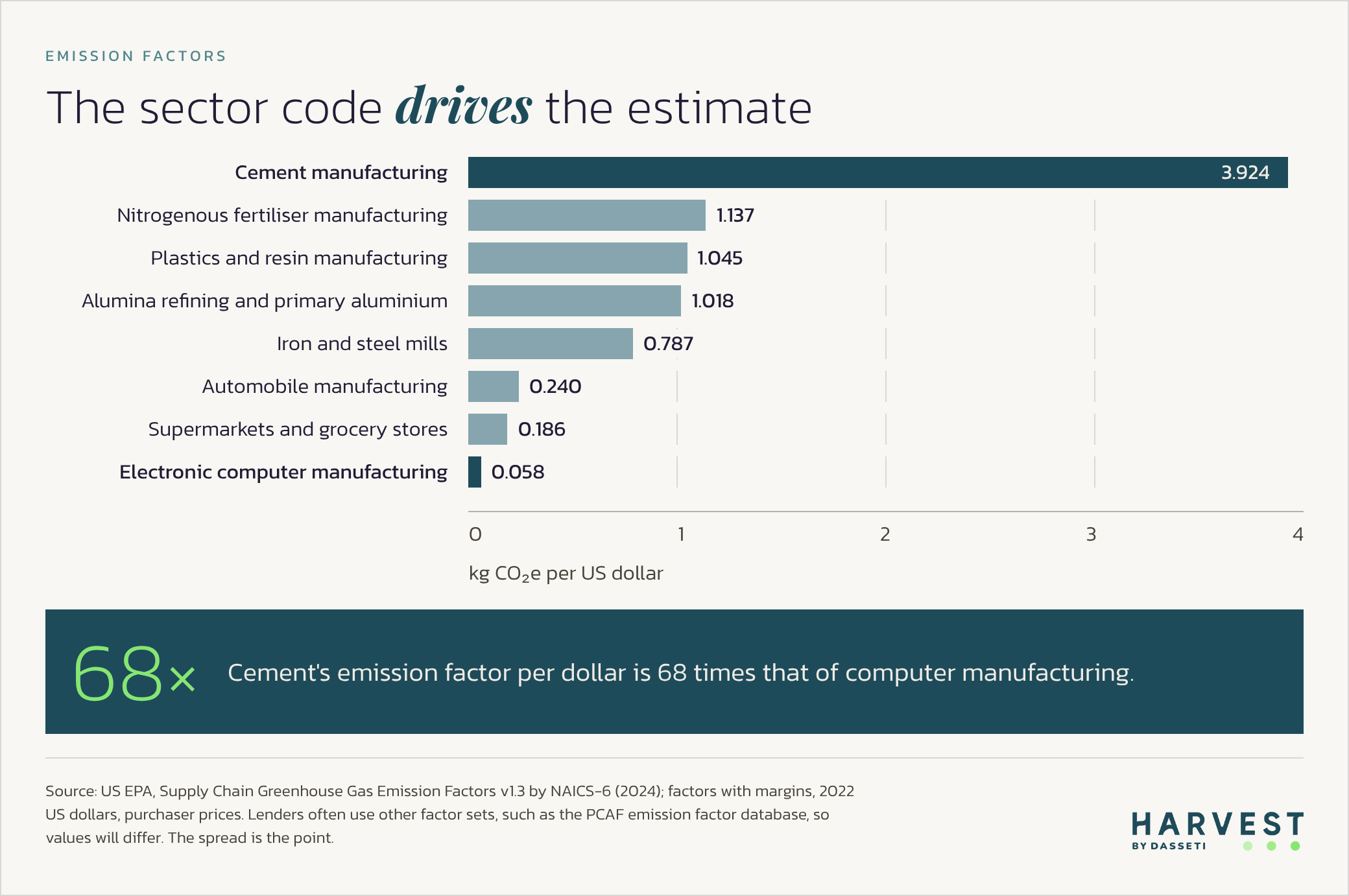
The spread between sectors is wider than most people expect. In the US Environmental Protection Agency's 2024 factor set, cement's emission factor per dollar is 68 times that of computer manufacturing. Choose the wrong code and the estimate inherits the wrong multiple.

Nobody set out to understate anything. The sector simply followed the legal borrower instead of the operation, and across a book that becomes a portfolio that looks cleaner than it is. The fix is a rule: the sector code belongs to the operating company, chosen once and written down.
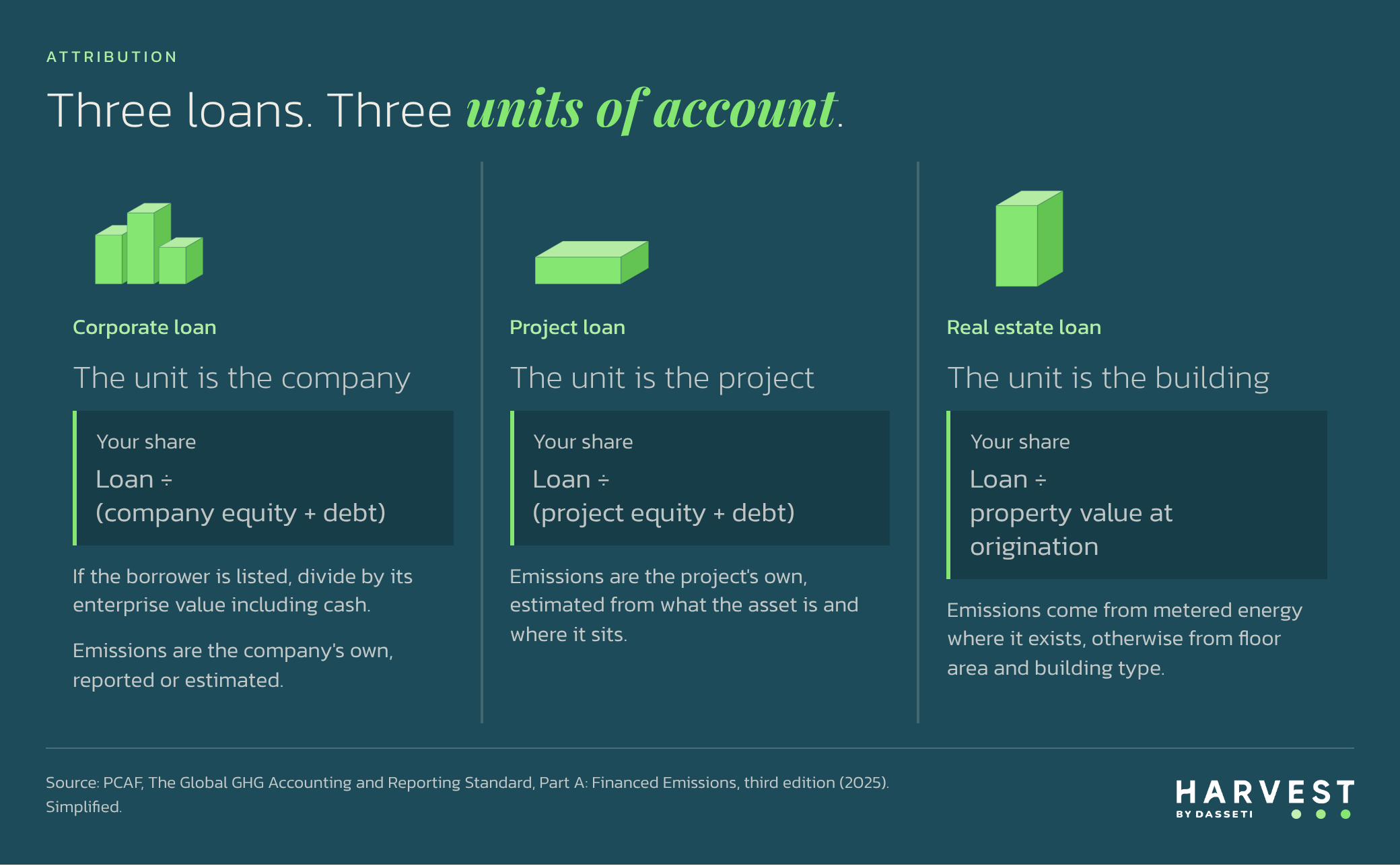
Naming the operating company settles the sector. It doesn't settle the method, because one credit fund can hold a term loan to a manufacturer, a project loan to a wind farm and a loan secured on an office block. PCAF, the financial industry's standard for this accounting, measures each against a different unit: the company, the project or the building.

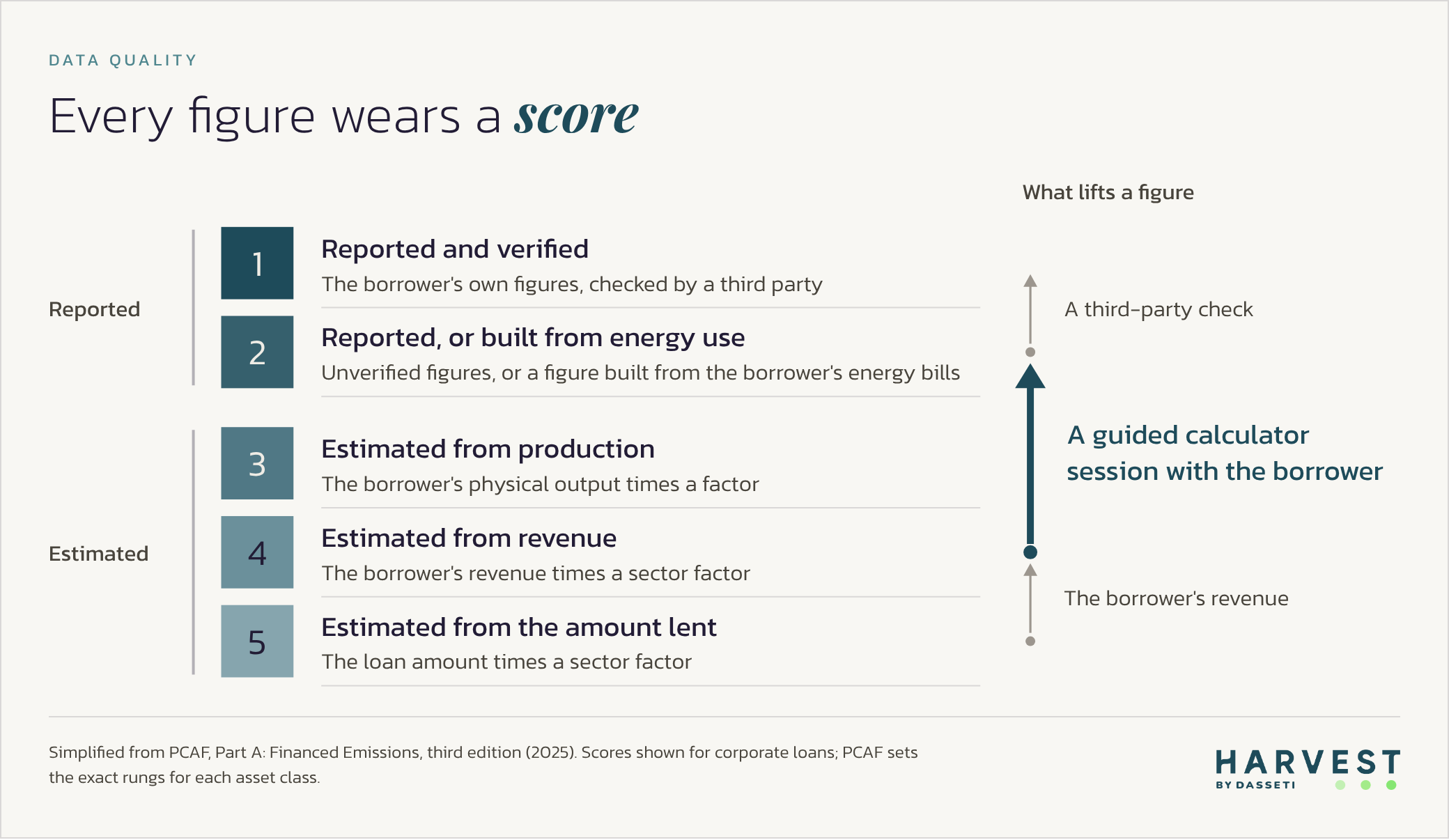
Every figure then carries a PCAF data quality score from 1, the strongest, to 5. Reported, verified emissions score 1. Estimates built from revenue or from the amount lent score 4 or 5. A weaker score is the context an auditor expects beside the figure, and a KPI for next year's request.

Now the uncomfortable part: most borrowers, left to themselves, will never send you a number. In a 2024 analysis of more than 58,000 companies held by private-capital funds, MSCI found that only 1,312 had reported Scope 1 and 2 emissions. That's 2.2 per cent. Private debt fared no better than private equity.
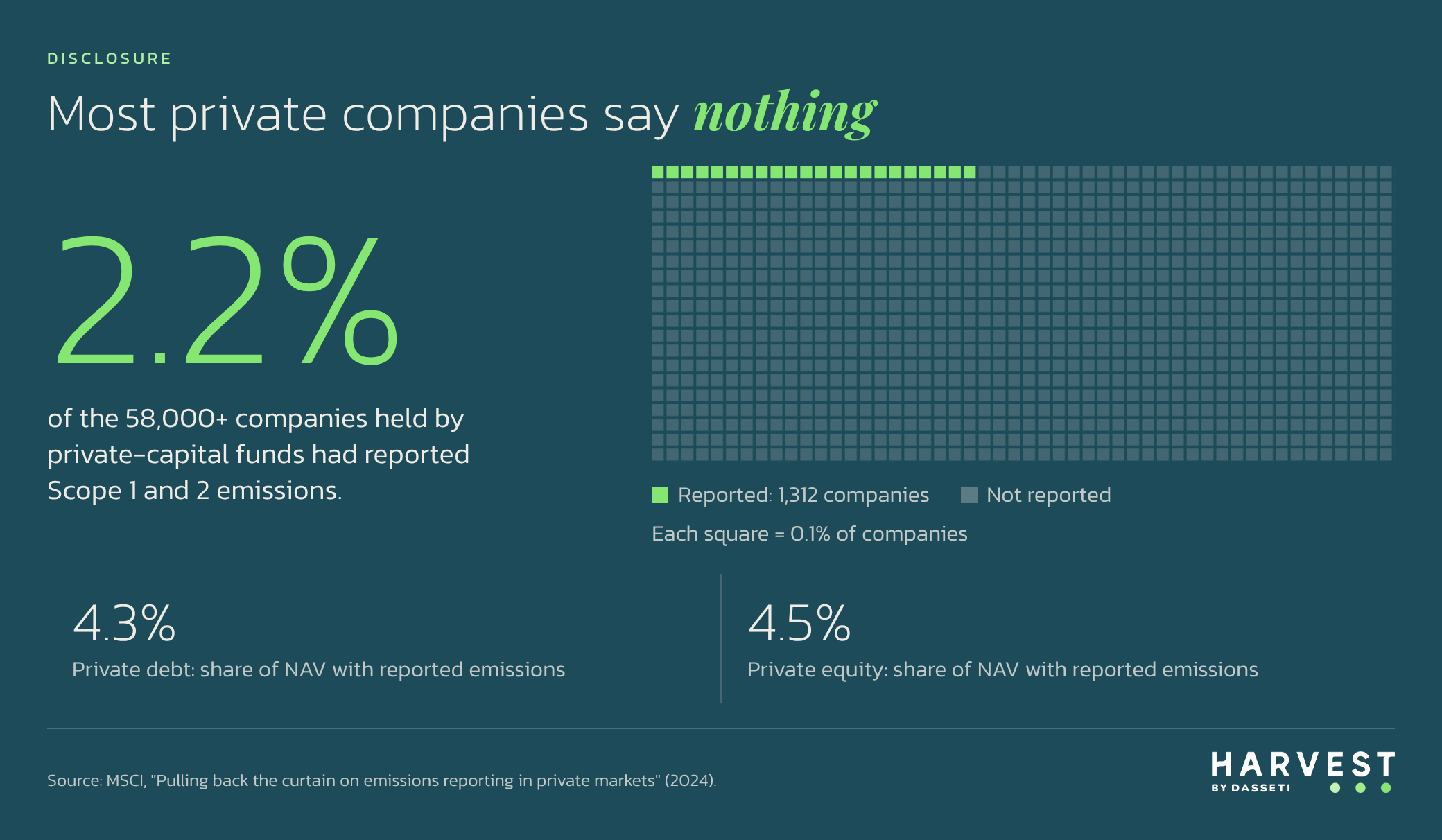
Credit makes it harder still. You lend; you don't own. There's no board seat, and the deal team guards the relationship. So the floor has to be a process that produces a defensible figure for every holding even if not one borrower replies. Plan for the zero-engagement portfolio. Most portfolios end up well above that floor, and the 2.2 per cent hides why.
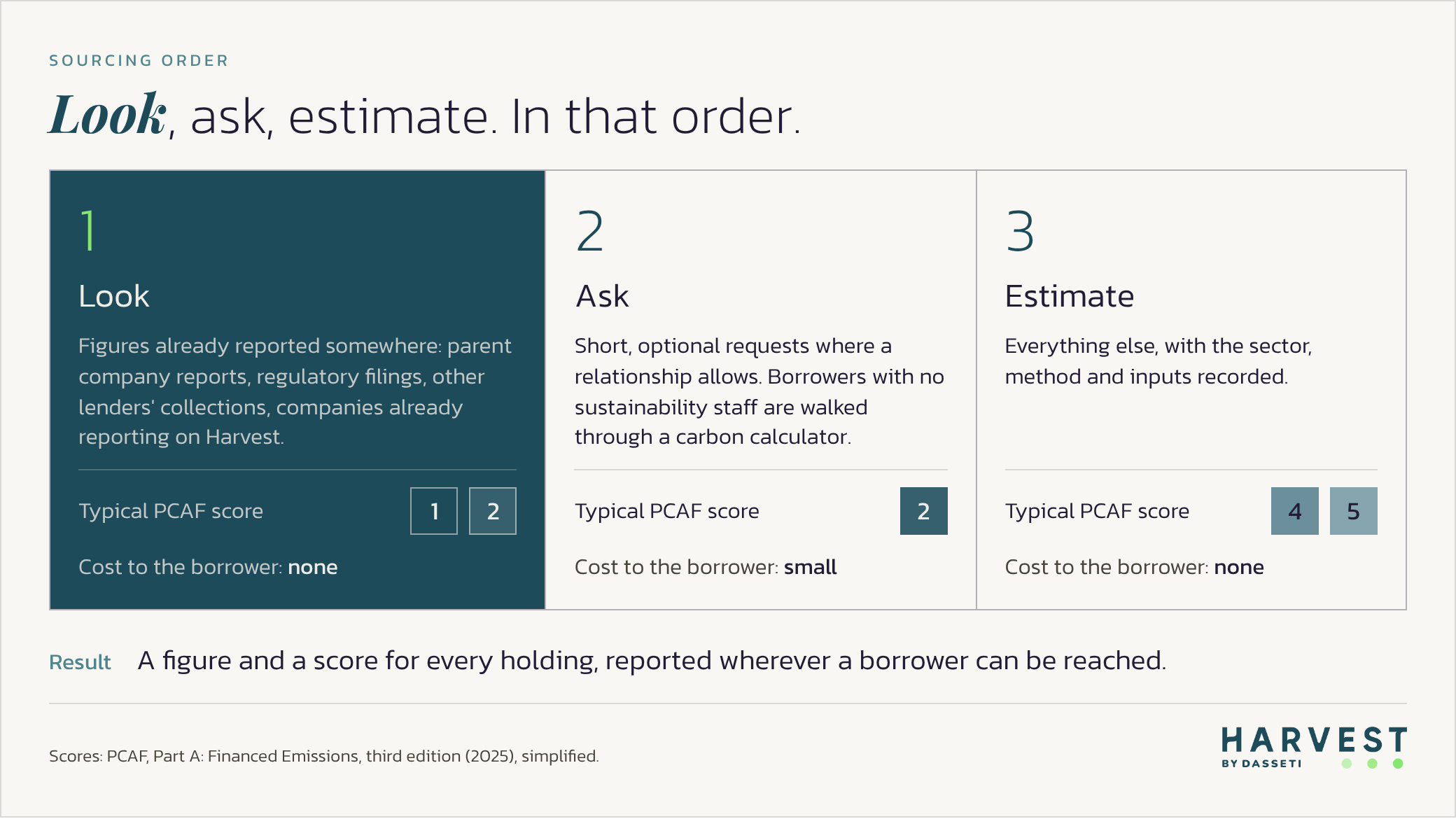
The emitter nobody named has often been named somewhere else. Its parent publishes an annual report. Its regulator holds a filing. It answered another lender's questionnaire last year, or it already reports to another manager on Harvest. Look before you ask, because looking costs the borrower nothing, and it turns up more than credit teams expect. In a recent portfolio assessment for a US private credit manager, the share of borrowers with reported emissions, by count, was several times what the manager had assumed.
Looking first isn't only thrift. It is the order the rules assume. IFRS S2 tells reporters to favour data measured directly, and specific to the company, over industry averages. So an estimate for a borrower whose own figure sits in its annual report is not the cautious choice. It is the number an auditor will ask you to replace.
Then ask, and make the ask easy to answer. A borrower with no sustainability staff won't fill in a spreadsheet, but it will sit down for twenty minutes with someone who walks it through a carbon calculator: fuel bills, electricity bills, floor area, done. The result is a reported figure built from the borrower's own activity data, which scores 2, rather than a sector estimate, which scores 4. In parts of the US a sustainability request can make deal teams nervous, so keep it optional and short, and clear the wording with legal first. Estimate the rest, and write down why.
Small, guided asks work. Metric, the US platform Dasseti acquired, built a submission flow for companies with no sustainability staff, designed to be as simple as filing a basic tax return online. Its clients often reached more than 80 per cent coverage across portfolios of small US companies.
Some borrowers will still have nothing to give: no report, no filing, no one whose job it is to count. For them an estimate is not a shortcut but the right answer, and the work is making a public average fit a private company. The sector does half of it. The borrowers that do report do the rest, because each is useful twice: once for its own figure, and again as a test. Set the estimate you would have made beside the number they reported, and the gap tells you how far to trust your estimates where there is nothing to compare. It is also what you should disclose. In its first observations on Australia's mandatory sustainability reports, in May 2026, the regulator ASIC asked for judgements, assumptions and areas of measurement uncertainty to be disclosed in a way that is "clear, effective and proximate". An estimate is a judgement. The test tells you how uncertain it is, and lets you put that right beside the number.
Estimation fills the gaps. It also opens two quiet ways to be wrong, and a rule closes each one.
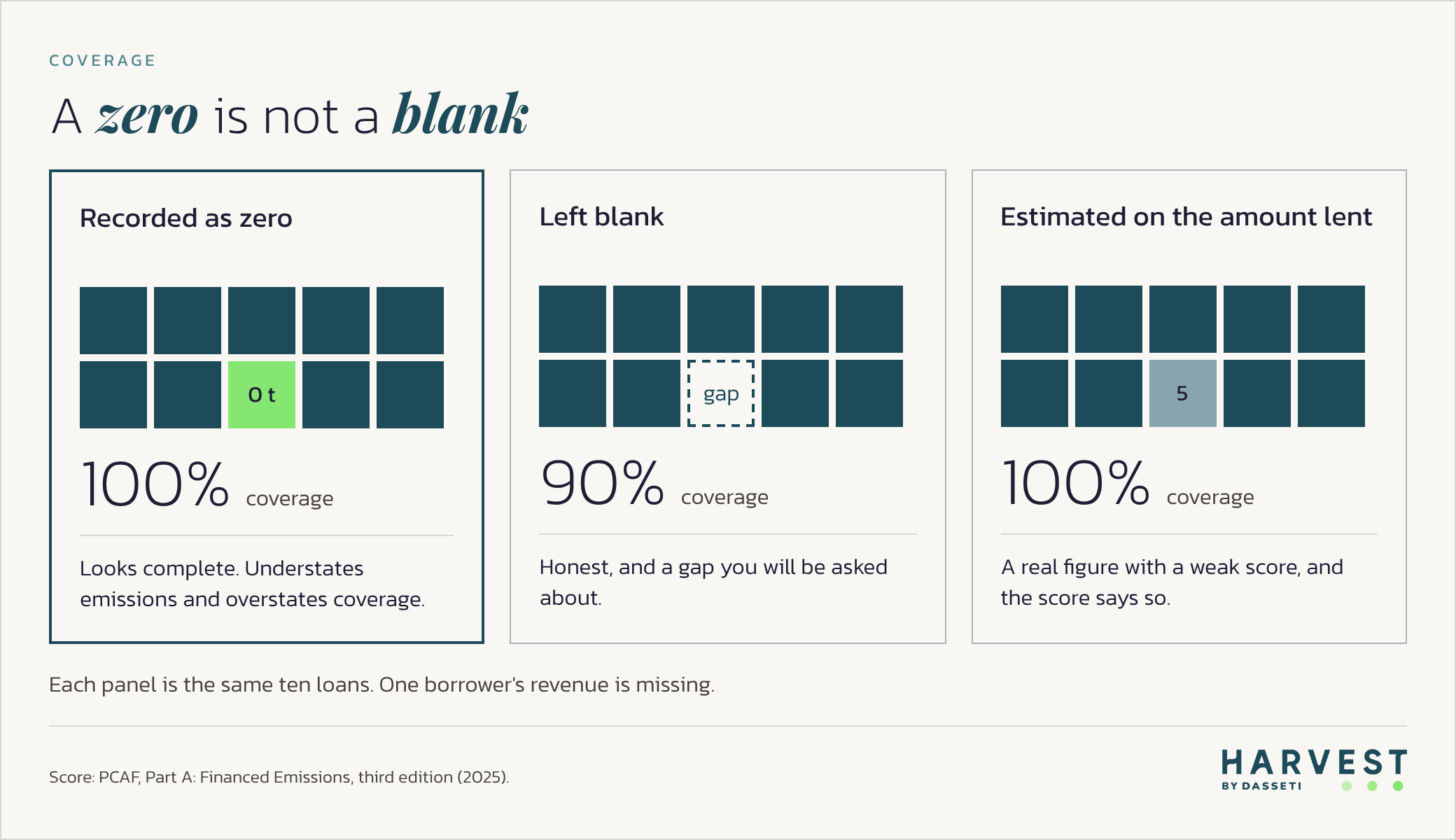
A zero is not a blank. When a borrower's revenue is missing, a revenue-based estimate can come back as zero. A zero looks like data, so it is counted as covered and adds no emissions. That is the one outcome to rule out. It is rarely a choice between the zero and a blank, either: with a sector and a country you can estimate from the amount you lent instead, which PCAF scores 5. Weak, and the score says so, but it is a real number and the holding stays covered. Leave it blank only when even that is out of reach, and let the blank show as the gap it is.

Lock the sector early. The sector belongs to the operating company; this rule is about when you choose it. Choose the code when the deal is approved, and keep it. If it drifts, the same borrower is estimated two ways in two years, and a change of method masquerades as a change in emissions. Decide your restatement triggers in advance, too. A new method is a reason to restate earlier years. A year of normal lending and repayment changes the portfolio, and needs no restatement.
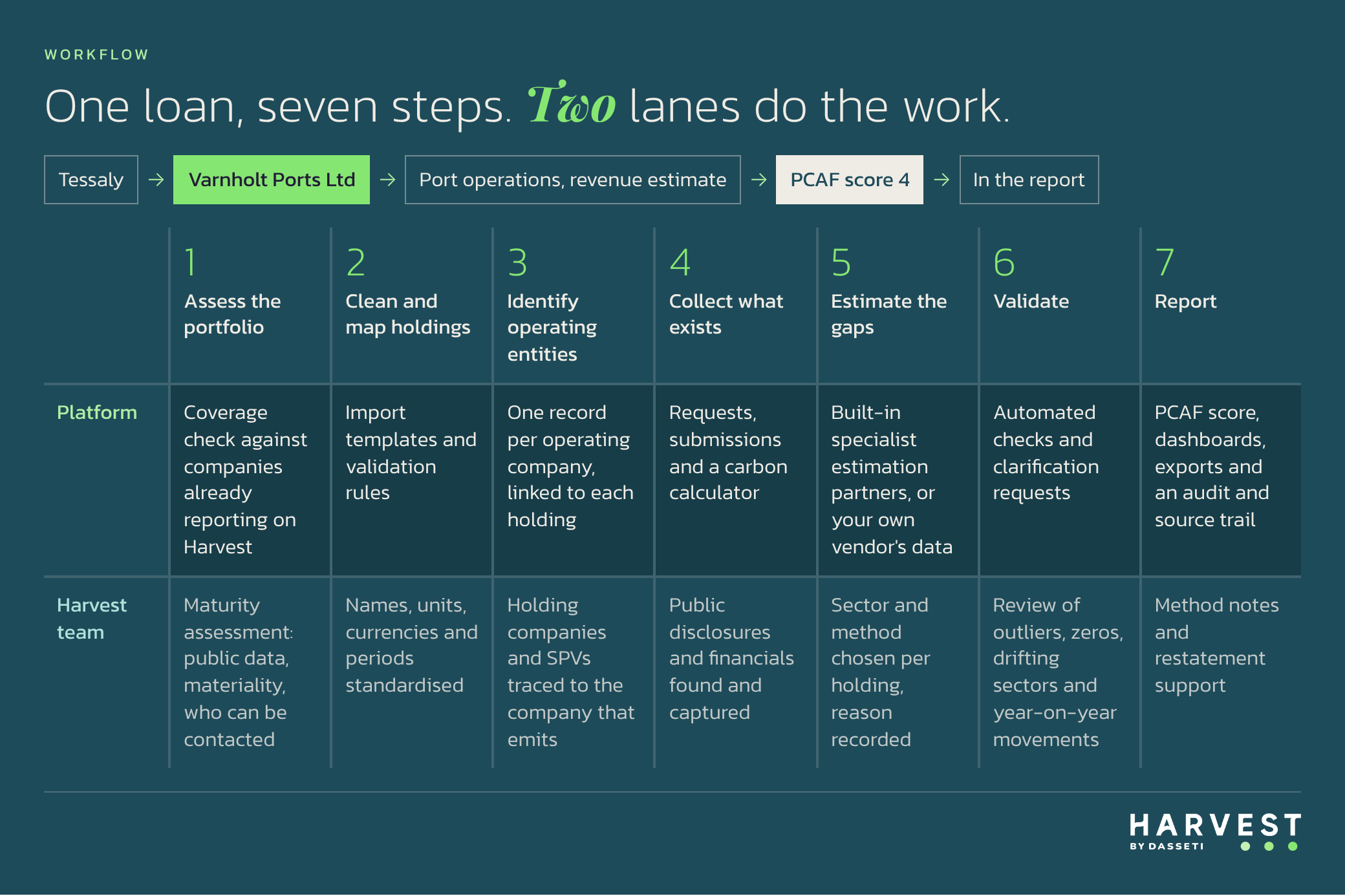
Put together, the work runs in seven steps. The first six are where the figure becomes defensible. The seventh is where investors see it.

If you report under IFRS S2, or a local version of it, such as Australia's AASB S2 or UK SRS S2, the last step has a set shape. Paragraph B61 asks an asset manager to show four things:
What IFRS S2 asks an asset manager to show
IFRS S2 doesn't prescribe a method for financed emissions, but it does expect you to describe yours. ISSB staff have described PCAF as commonly accepted.
US managers without a mandatory framework meet the same questions through their investors' questionnaires. Australia's AASB S2 has its own modifications and application rules. Check which requirements apply to your organisation.
Harvest by Dasseti runs the seven steps as one process, as software or as a managed service. The platform checks your positions against the companies already reporting on Harvest, collects what borrowers can give, walks the ones who need it through a carbon calculator, estimates the rest through built-in specialist estimation partners or your own vendor's data, and keeps an audit and source trail behind every figure.
Our team takes on the work in between that usually lands on yours: the assessment, the cleaning, tracing holding companies to operating companies, finding data that has already been reported, choosing sectors and methods, and reviewing the result, including how it moved since last year. You get a financed emissions figure and a PCAF data quality score for every holding in scope, reported wherever a figure exists or can be built with the borrower, and estimated only where it can't, with the reasoning written down.
Go back to the position.
Tessaly · Term loan B · EUR 45m · Senior secured
It is still a code name for a loan to a holding company, and it still says nothing about carbon. It never will. The figure your investors see is the last of seven steps. The six before it are what let you put that figure in front of a CIO or an auditor, and hold your ground.
They multiply each borrower's emissions by their share of its financing. Under PCAF, that share is the outstanding loan divided by the borrower's equity plus debt for a private company, or by its enterprise value including cash if it is listed. Emissions are reported where the borrower discloses them and estimated from activity data, or from revenue and sector, where it doesn't. Each figure carries a data quality score.
Look before you ask: many borrowers have already reported somewhere, in a parent's report, a regulatory filing or another lender's collection. Where nothing exists, a short guided session through a carbon calculator turns a borrower with no sustainability staff into a reported figure. Estimate the rest from revenue and sector, record why, and give every figure a PCAF data quality score.
The operating company's. A holding company or special purpose vehicle rarely emits anything itself. Trace each borrower to the company that runs the assets, estimate at that level and use that company's sector code. Otherwise a revenue-based estimate applies a low financial-services factor and understates the portfolio.
It depends on what the estimate is built from. PCAF scores every figure from 1, the strongest, to 5. For a corporate loan, emissions the borrower reports score 1 if verified and 2 if not, as does a figure built from its own energy use. An estimate from its production data scores 3, from its revenue and a sector factor 4, and from the amount lent and a sector factor 5.
Yes, where IFRS S2 or a local version of it applies. Paragraph B61 asks for absolute gross financed emissions by scope, the assets under management included, that amount as a percentage of total assets under management, and the method, including how emissions were allocated. IFRS S2 doesn't prescribe a method. Check which requirements apply to your organisation.
Discover how transforming ESG data into structured investment intelligence can enhance decision-making and drive long-term value in asset management.
The pressure in ESG reporting sits downstream - where disparate data must be normalized, validated, and made disclosure-ready.
Discover how centralized systems can transform ESG reporting cycles, enhancing oversight, audit trails, and governance while addressing common...
Stay up to date with the latest insights from the Dasseti team.